
The inquiry into the administration of the NDIS has been published
A Big Week for the NDIS in Parliament, and What It Means for Providers
This briefing pulls together three developments from Canberra in the last week of October, what they say about accountability, and what they mean for NDIS providers. If you only read one section, read the actions at the end.
The week at a glance
• Wednesday 28 October. The NDIA Annual Report 2025–26 was tabled. The Government announced a new NDIA Board Chair.
• Thursday 29 October. The Joint Committee of Public Accounts and Audit (JCPAA) tabled Report 519, its inquiry into the administration of the NDIS.
• Still to come. The NDIS Commission's 2025–26 annual report had not been published as at 30 October.
Context
A new Chair for the NDIA Board
Dr Graeme Innes AM will become Chair of the NDIA Board on 17 December 2026, for a three-year term. He replaces Kurt Fearnley AO, who is stepping down to spend more time with his young family.
Dr Innes is not new to the NDIS. He was Australia's Disability Discrimination Commissioner from 2005 to 2014, the years in which the NDIS was designed and legislated. He joined the NDIA Board in September 2022, and chaired its Audit and Risk Committee in 2025–26. He said "My priority will be ensuring that the NDIS upholds the rights of participants, and delivers meaningful, sustainable outcomes."
Two new Board members were also announced. Glenn Keys AO is a business leader and parent of a person with disability. Dr Kim Isaacs is a GP and an advocate for better outcomes for First Nations communities. Dr Isaacs has experience in rural and remote service delivery and Aboriginal primary health care.
Report 519, the audit committee's verdict on how the NDIS is run
The JCPAA reviewed a series of Auditor-General reports on the NDIA and the NDIS Commission, and examined the Department of Health, Disability and Ageing's policy advice. It made 14 recommendations.
The Chair's foreword sets the tone. Frameworks and controls "alone are not sufficient," and "assurance that they are working as intended, is vital."
Key findings for providers.
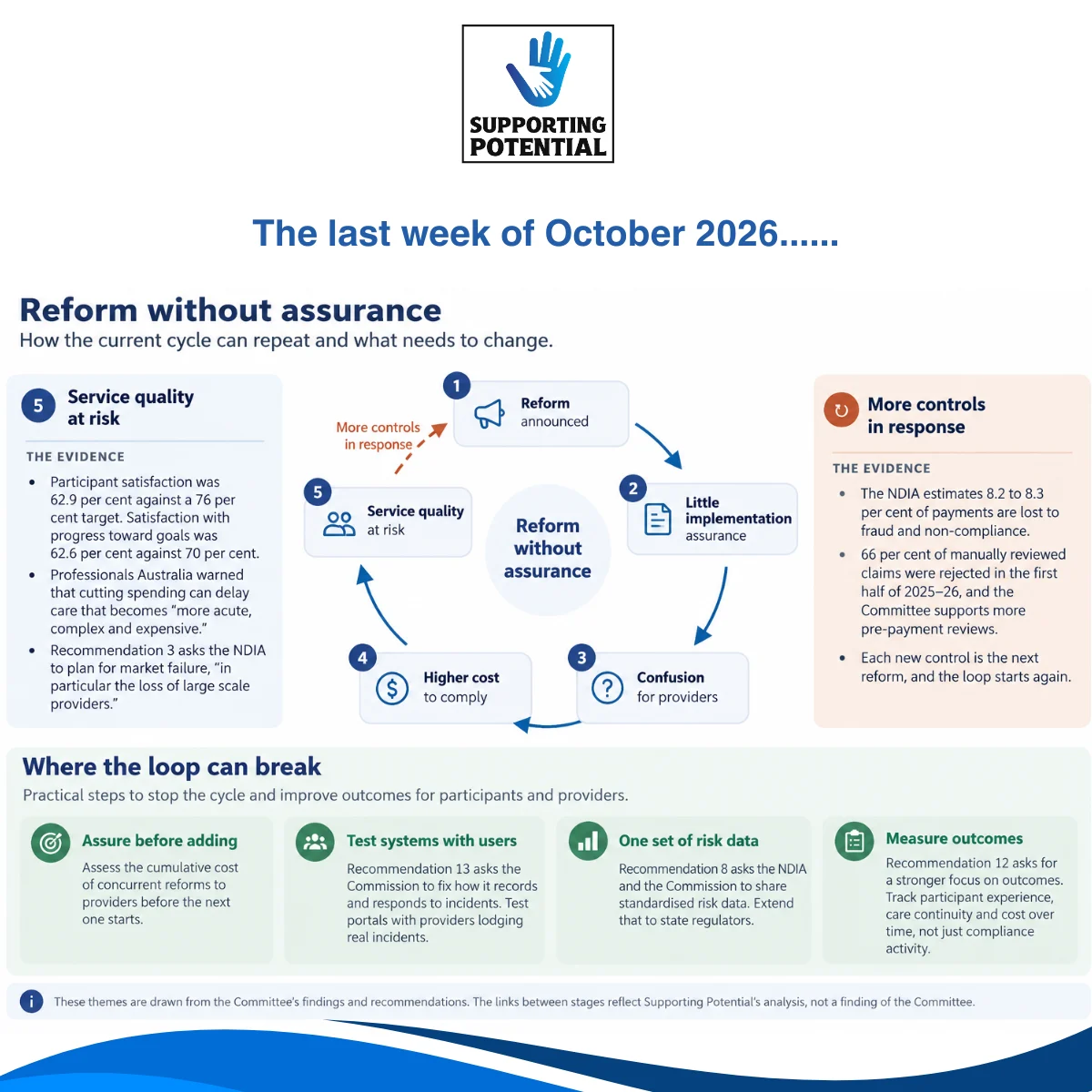
• Integrity leakage. The NDIA estimates 8.2 to 8.3 per cent of scheme payments are lost to fraud and non-compliance. That is around $4.0 to $4.1 billion in 2025–26.
• Pre-payment checks. Only 0.4 per cent of claims get a manual pre-payment review. Of those reviewed in the first half of 2025–26, 66 per cent were rejected. The Committee called the level of detection controls "not acceptable."
• Savings. The NDIA's realised savings of about $160 million a year are roughly 4 per cent of estimated leakage.
• The Commission. The Auditor-General found it "partly effective." At the time of the inquiry it did not yet have a full enterprise-level regulatory risk framework. Its Quality Assurance Framework is only being piloted.
• Complaints. One disability legal service described complaints to the Commission as "very much a one-way process." The Commission relies largely on complaints and tip-offs to see unregistered providers, who made up 94 per cent of active providers in the last quarter of 2024–25.
• Performance measures. On measures that have no targets, the Committee wrote that "the NDIA is counting for the sake of counting something."
Recommendations that matter most for providers.
• Rec 3. The NDIA should monitor and mitigate the risks of market failure, "in particular the loss of large scale providers."
• Rec 12. The NDIA and the Commission should strengthen monitoring and reporting of participant outcomes.
• Rec 13. The Commission should improve how it records, prioritises and responds to complaints and incidents, so that information "flows to outcomes and risk reporting."
• Rec 14. The Commission should develop a risk-proportionate registration framework. Factors would include the risk of the supports, professional qualifications, complaints history and quality of services. The framework should also identify supports that only registered providers should deliver.
The NDIA Annual Report 2025–26
The annual report was tabled the day before Report 519, so it does not respond to it. Read side by side, my reading is that both show integrity controls and outcome measures lagging behind scheme growth.
• Targets missed. The NDIA missed 6 of its 14 performance measures. Scheme growth was 10.5 per cent against a 9.4 per cent target. Participant satisfaction was 62.9 per cent against a 76 per cent target. The Participant Service Guarantee sets timeframes for NDIA processes such as plan changes. A guarantee counts as met when at least 95 per cent of tasks are on time, and the target was to meet 80 per cent of guarantees. The result was 46.6 per cent, up from 10 per cent in 2024–25.
• Pre-payment review. The pre-payment team reviewed 72,965 claims worth $212 million. More than 50,000 claims, worth $141 million, were rejected. That is more than two-thirds of the claims reviewed.
• Claim holds. More claims were held longer than three days for integrity checks. The NDIA introduced a 7-day hold on support coordination claims where there is no established provider relationship, which it says aligns support coordination with other categories.
• The integrity measure is changing. "Claim integrity checks" becomes "claim integrity interventions" from 2026–27, covering more of the claims life cycle.
• The reform projections rest on assumptions. After reforms, growth is projected to drop from 6.0 per cent in 2026–27 to 0.1 per cent by 2029–30. The reviewing actuary from the Australian Government Actuary said he had "not yet been provided with sufficient detail" to say whether that projection is a best estimate.
• More audits are coming. The Auditor-General has started audits of the Fraud Fusion Taskforce's effectiveness and of market stewardship in the care and support economy. Both are due in 2026–27.
Who is accountable, and what is working
Report 519 does not find anyone legally liable. A parliamentary committee cannot impose penalties or order an agency to act. What it does is name the legal duties it found were not met, and set out how the agencies will be held to account.
Duties the Committee found were not met.
• The NDIA Board. The Board "was not able to provide evidence that it had actively given strategic direction" on financial sustainability, "as it is required by legislation to do."
• NDIA fraud controls. The Auditor-General found the NDIA's Fraud and Corruption Control Plan non-compliant with the PGPA Rule, because the Board had not endorsed an update to meet new Commonwealth requirements from 1 July 2024.
• NDIA reporting. The NDIA's annual sustainability report does not state whether the NDIS is sustainable, although that assessment is a legislative requirement. The Auditor-General qualified the NDIA's 2023–24 performance statements for leaving out fraud and non-compliance.
• The NDIS Commission. It had not documented its market oversight approach, "despite this being a core legislative function." It did not know how effective its complaints management was, "despite complaints management being a legislated function."
• Health. Asked twice, the Department could not identify any lessons it had learned from its own reform implementation.
How the agencies will be held to account. Eight recommendations require the agencies to report back to the Committee, the first within six months. The Government is also expected to respond formally. Senate Estimates and further Auditor-General audits continue alongside.
The report is not all criticism. The committee rightly pointed out some positive advancements, which included:
• The Auditor-General found the NDIA Board's governance "largely effective," and the NDIA agreed to all three of that audit's recommendations.
• The first tranche of the Crack Down on Fraud program was "largely implemented on time and under budget." The Committee "recognises the work of NDIA in implementing the CDoF program."
• The Committee acknowledged the work of the Fraud Fusion Taskforce, and "the size and complexity of the NDIS, and the capabilities of those administering the scheme."
• The NDIS Commission agreed to nine of the Auditor-General's ten recommendations, and agreed to the tenth in principle. Since the audit it has introduced a risk-based prioritisation model, finalised a Data Quality Framework, and begun piloting a Quality Assurance Framework.
• The Committee acknowledged the Commission's compliance frameworks and strategic roadmap. It said it is "hopeful" the Commission's data transformation will deliver usable data.
• Health's policy advice to government "covered a relevant range of topics."
My Take
The reality that service providers have been living within is now being asked of the agencies too. For years the Commission has been shifting from checking that systems exist to checking that systems work. This week a parliamentary committee applied the same test to the NDIA and the Commission, and found both falling short.
That matters for providers in three ways.
First, claim scrutiny is likely to increase. When the NDIA's own figures show more than two-thirds of reviewed claims rejected, and the Committee calls the level of detection controls "not acceptable", expect the review rate to rise. The NDIA will also report on integrity activity across more of the claims life cycle. The 7-day support coordination hold shows how quickly a new control can affect cash flow.
Second, your data is likely to become more visible. Recommendation 8 pushes for shared outcomes and risk data between the NDIA and the Commission. Recommendations 11 and 13 push the Commission to analyse complaints and feed complaints and incidents into risk reporting. The Commission said fragmented data limited its ability to "link complaints to provider history," and says its data transformation program is meant to fix that. Patterns in your complaints and incidents are likely to become more visible to the regulator.
Third, outcomes are still on the table. Recommendation 14 points to registration requirements matched to risk, with complaints history and quality of services as factors. Recommendation 12, and the reviewing actuary's comment that sustainability is supported by "both the quantity and quality of the Scheme expenditure," point to outcomes, not activity, becoming the measure.
Fairness?
When a provider cannot show its systems work, it faces compliance action and, under this year's amendments, very significant civil penalties. When the funder and the regulator fall short of their own legislated functions, the consequence is a report-back and another hearing.
That is not an excuse for providers to cease striving for improvement. But it does pose a fair question to government.
As the reforms roll out, how do you KNOW the action you are taking is fulfilling the purpose and intent of the scheme?
For the new Chair, this may feel like Groundhog Day. Dr Innes has watched the NDIS from its beginnings, first as Disability Discrimination Commissioner and, since 2022, from the Board table. The Auditor-General audited the Board's effectiveness in 2025. Report 519 now finds many of the same gaps still open.
• The NDIA's claim compliance framework "remained underdeveloped," although the agency has been established for over a decade.
• The NDIA had yet to update its fraud and operational risk assessments to reflect known risks and control weaknesses.
• Eight years after the Commission was established, the Committee found its continuing "maturity journey" "underwhelming."
Recommendation 1 asks the Board to report back within 12 months on the strategic direction it has given management. That report is likely to land while Dr Innes is Chair. He brings more than 30 years as a human rights practitioner. He has also chaired the Board's Audit and Risk Committee, whose remit covers fraud risk, internal control and performance reporting, the same areas the Auditor-General and the Committee criticised. That cuts both ways. He knows where the gaps are, and he shares responsibility for them. The first test comes early. Recommendation 6 asks for a report on the NDIA's fraud and operational risk assessments within six months. How will we KNOW it is working? That report will be the first evidence.
Action
With that in mind, here is what to do now.
• Test your claims before the NDIA does. How do you KNOW that every claim lodged last month could be substantiated within days if asked? Pick a sample, pull the service records behind each one, and see how long it takes.
• Model the cash-flow impact of holds. If you deliver support coordination, check how many of your claims could fall under the 7-day hold. Check which holds already apply to your other support types. For everyone, assume more claims will be held for review, and know what a two-week delay on a share of revenue would do.
• Look at your own complaints and incident patterns first. Review your last 12 months by site, support type and team. Ask what a regulator who could see all of it would conclude.
• Start measuring outcomes, not activity. Pick two or three participant outcomes your supports are meant to change, and start tracking them. Activity counts alone are unlikely to satisfy regulators for long.
• If you are unregistered, watch Recommendation 14. If you deliver higher-risk supports, plan for registration being required. If you are registered, your complaints history and evidence of quality may start to count for more.
• If you are a large provider, expect questions about continuity. Recommendation 3 names the loss of large providers as a market risk. Have a clear answer on financial viability and how you would protect participants if a service had to close.
The NDIS Commission's annual report is due shortly, and agency report-backs on Report 519 begin around April 2027. I'll keep tracking both.
Sources
• Joint Committee of Public Accounts and Audit, Report 519: Inquiry into the administration of the National Disability Insurance Scheme, tabled 29 October 2026. Inquiry page.
• Committee media release, "Audit Committee tables report into administration of the NDIS", 29 October 2026.
• NDIA, Annual Report 2025–26, tabled 28 October 2026. NDIA annual report page.
• Minister Butler, "New NDIA Board Chair and members announced", 28 October 2026.
• Paralympics Australia, "Paralympic legend to lead NDIA Board", 26 September 2022, on Dr Innes joining the NDIA Board.
• Wikipedia, "Graeme Innes", for his 2005 to 2014 term as Disability Discrimination Commissioner.
• NDIS Commission corporate reports page, checked 30 October 2026, lists 2024–25 as the latest annual report.